Monday, December 19, 2011

Looking Back at 2011 and 9/11

Looking back on this year, I came across as I was googling, a letter I wrote after 9/11 that was published first on 13 September 2001 and then reprinted this past September 13, 2011 when the Orange County Register republished letters reacting to 9/11.

Here's what the OC Register republished 13 September 2011, under the heading, "9/11 archive for Sept. 13: Another day of anger, grief," on the blog written by letters editor Betty Talbert. I like to think that my words still hold true a decade or more later:

IRVINE, Daniel C. Tsang: Not to condone the massacre and the horrible loss of life, but if the United States isn’t perceived as such an imperialist power causing havoc in the Third World, this country would not be a target of terrorism. To be sure, find and prosecute the perpetrators. But will the real lesson be learned? As a political entity, the United States needs to reassess its foreign policy. But no doubt, repressive legislation and repressive actions will follow instead.

They say it is a second Pearl Harbor. Will roundups and concentration camps be next? Let’s not go overboard on our reaction. If four crazy hijackers want to be suicidal, it’s not because of their religion.

Let’s not go overboard either on patriotic fervor. If this is war, civil liberties will become one of the first casualties unless we speak out. Sanity, calm and reflection are what is needed now, not vengeance. No more violence.

Tuesday, December 13, 2011

Tom Hayden, at UCI, Looks Back and Ahead

Hayden as professor. To listen to the audio of Hayden's talk, click . Presented with the kind permission of Tom Hayden as another Subversity Online podcast. All photos © Daniel C. Tsang 2011.
60's activist Tom Hayden ventured on to the UC Irvine campus late last month, to espouse his views to a new audience of largely undergraduates organized by graduate student Alfredo Carlos and Social Ecology Prof. Rodolfo D. Torres.

A former California State Senator, Hayden spoke about "Economic Democracy and Alternative Futures" 29 November 2011 at UCI's Humanities Gateway, at an event sponsored by the Chican@/Latin@ Graduate Student Collective.

Hayden, a one-time Chicago 7 defendant who had authored the Students for a Democratic Society's manifesto, the Port Huron Statement, while a student at the University of Michigan, sounded more reformist than perhaps some old Sixties radicals would have liked. He said one needs take a long view of social movements, given that success may be elusive for decades, even for 80 years.

A pensive Hayden
He called the Dream Act undergraduates the "bravest" and said the cause of undocumented students in California is so "popular" that politicians like Los Angeles Mayor Antonio Villaraigosa and Lt.Gov. Gavin Newsom could take on that campaign with nothing to lose.

He said the "Sixties were stolen" by assassinations, of JFK, Robert Kennedy, Martin Luther King Jr., Malcolm X, Medgar Evers. With the dreams stolen from them, "no wonder people become anarchists..."

But before his hour and half discourse on the Sixties through Obama ended, he called on the "fine" dean of the UCI Law School (without naming Erwin Chemerinsky) to have UCI law faculty conduct classes there debating the concept of corporations as people having First Amendment rights to spread propaganda. He avowed that such courses could well "fire up" students and spread across the nation, leading to the U.S. Supreme Court overturning the notorious 2010 case, Citizens United v. Federal Election Commission.

Hayden answers questions from the audience

Friday, December 2, 2011

Historian Art Hansen on Orange County Nikkei Experience in WWII

Art Hansen right before his talk. Photograph © Daniel C. Tsang 2011.

KUCI Subversity Online Audio link: 19 October 2011 Talk. Permission kindly granted by Prof. Hansen to post the audio online.

A LOOK BACK on 2011: Orange County's top historian on Japanese Americans gave a vivid and fascinating talk on a segment of OC history that many do not know or may have forgotten if they knew it.

At the Nikkei Heritage Museum on 19 October 2011, Cal State Fullerton Historian Art Hansen focused on the life of OC-born Kazuo Masuda and the conditions faced by Japanese Americans in Orange County at the time. Masuda went from what became Fountain Valley to concentration camp (NOT "internment" camp as the US Government euphemistically called it) to fight for the US in the famed 442nd regimental combat team made up of Japanese Americans. After he was killed in battle in Italy, his body was initially refused burial in Westminster Memorial Cemetery because of his ethnicity, although the cemetery later relented after the Japanese American Citizens League and others raised a ruckus. It was Lt. Gen. Joseph W. Stilwell who flew to Orange County to bestow the Distinguished Service Cross in 1945 on his sister.

At an OC rally after the ceremony, Hollywood celebrities joined a multi-ethnic crowd. Among the guest speakers was a Capt. (Ret.) Ronald Reagan who declared, after turning to the Masuda family to thank them for Kazuo as a "true American": "Blood that has soaked into the sands of a beach is all one color."

Decades later the Masuda family reminded Reagan (by then president) of this 1945 speech when he seemed initially unwilling to sign the redress bill that compensated who survived the incarceration. Masuda's sister, June Masuda Goto, wrote to Reagan and convinced him to support the bill. Reagan invited her to Washington and she was present when the president signed it in 1988. In 1975 an school in Fountain Valley had also been named Kazuo Masuda Elementary School.


Art Hansen illustrated Kazuo Masuda's life with slides depicting the various events in the Japanese American's life. The story of this Nissei war hero from OC is also told in a book available at the event, From the Battlefields to the Home Front: The Kazuo Masuda Legacy by Russell K. Shoho and published by the Nikkei Writers Guild, a division of Japanese American Living Legacy, a non-profit.


Participants also heard from Irvine artist Chizuko Judy Sugita DeQueiroz, whose book, Camp Days, 1942-1945, documented, in text and artwork, her years of incarceration. She presented excerpts from a new documentary DVD about her life. Her artwork is currently on display at the Japanese American Museum of San Jose until December 31, 2011.

Thursday, December 1, 2011

Free Speech At UCI: Shut Down Access Roads!


Let's not cross the police! Police lines block access to free speech area

___________________________________
Update (6:30 pm): Chancellor Michael Drake issues a statement saying "Our campus policies treat all speakers equally. We regulate only the time place and manner of speech on a 'content-neutral' basis, as required by state and federal law and university policy. This is true no matter how strongly we may disagree with the speaker or how antithetical the speaker’s message may be to campus values and principles" but Drake does not address the earlier report of UCI telling Jones he would be arrested should he show up.

Update (2:29 pm): Jones threatened with arrest if he shows up... UCI spokesperson says: ""We're not denying him access to the campus, just that particular area because it was already spoken for", while Jones says that "The Event Services department informed us that the entire university campus is free for public speaking at any time." Dispatch in Daily Breeze. See also OC Weekly update, where another UCI spokesperson said "Jones was in contact with UCI officials this morning, and was told he would be arrested if he returns in order to 'protect the safety of UCI students and the campus community'."
___________________________________

It may be the biggest non-event in UC Irvine history. This morning, campus police at UC Irvine shut down roads leading to the flagpoles area (where speakers usually gather) and even restricted pedestrian traffic. All because, as UCI employees soon found out, Terry Jones, the Florida pastor who burned the Koran last March, was rumored to be speaking on campus.

Is this how UCIPD will react to controversial speakers post-UC Davis pepper-spray? Forget all the talk about the UCs being open to free speech. Let's just shut down part of the campus so no one can address anyone. If this is not content-based restriction, masking under the fig leaf of security, what is?

I first encountered this heightened state of security, it turned out, when I attempted to drive to my usual parking spot across from Langson Library this morning. The road was blocked and I had to park in a parking structure some ways away. But I was not allowed to walk on the road to the Library. Instead, a man wearing a UCI parking jacket said it was for "protest detail" -- and that I had to go through the student center building and walk another way to my office.
Chalk asks if tuition is paying for this police action

A 9:55 am email from a unit of the Libraries informed me that: "Without any advance notice from campus, the delivery access to Langson
Library has been closed off from Pereira. I don't have any information
at this time other than campus PD is enforcing this. Therefore,
deliveries (mail, vendors, etc.) today will be off schedule...."

A campus-wide ZOTAlert soon followed at 10:33 am: ZotAlert: Anteater Plaza, Ring Rd, flagpoles, and Pereira are closed immediately to pedestrian and vehicular traffic until further notice for security reasons.

This was followed at 11:23 am by a Safety Update: Terry Jones, the Florida pastor who made news by burning the Quran last March, announced he would be speaking in the area of the flag poles at 11:30 on Thursday, Dec. 1. Intelligence received by UCIPD
indicated suspicious activity that raised concern about the safety of
the event. As a precaution the area has been closed and no events will
take place in this area. Other campus activity is continuing as normal.
News photographers wait for missing pastor

Further ZotAlerts followed two minutes later: The pastor who made news by burning a Quran, announced he would speak at the flag poles today. UCIPD has intell of suspicious activity raising safety concerns.

And at 11:26 am: As a precaution, the area has been closed and no events will take place. Otherwise, the campus is open and operating normally.

As the UC begins reviewing police practices systemwide, today's campus police response should serve as an excellent case study of how not to over-react in a free speech situation. The police department has a lot of explaining to do. At a minimum, reveal what the "security concern" was and let the public judge. -- Daniel C. Tsang.

All photographs © 1 December 2011 Daniel C. Tsang

Tuesday, November 29, 2011

UCI Police Interpret When to Use Force

UCIPD officers begin arresting Irvine 17 protesters outside UCI Chancellor's Office in February 2010.
Photograph copyright 2010 Daniel C. Tsang

Three hours after UCI History Prof. and a leader in the UC Council of Faculty Associations Mark Levine and I met with UC Irvine assistant police chief Jeff Hutchison and Lt. Joe Reiss, where we were given a copy of UCI Police's Use of Force policies, UCI Chancellor Michael Drake released on the web copies of the same policies.

This meeting occurred before Thanksgiving, on Monday November 21. Right before leaving the one-hour meeting, I asked Asst. Chief Hutchison if he would consider posting the policies online, given they are "not secret".

In fact, the 17 pages of various use of force policies that saw the light of day hours after our meeting were just a miniscule portion of the 434-page policy manual followed by the UC Irvine Police Department.

What was given to us and made publicly available later were policies 300 (Use of Force), 308 (Control Devices and Techniques), which includes Chemical Spray Guidelines, 309 (TASER Guidelines), and 424 (Rapid Response and Deployment Policy).

Hutchison argued the campus cops would "not use" chemical spray for
"passive resistance," although he suggested that passive resistance is no longer passive if protesters link arms and refuse to budge. That's because it may lead police to use "intermediate force" to break people apart. But if there is no urgency to act, the police would rather wait and consult with other campus authorities, we were told. Cold comfort! Campus protesters will be surprised to learn that passive resistance (locking arms) can be deemed active resistance. Despite all the campus rhetoric about Free Speech, it seems the campus cops do not consider civil disobedience to be passive resistance if the protestors link arms and refuse to budge.

Drake also released a page of UCI Police Manual Policy 352 on Outside Agency Assistance, which we were not given at the meeting nor discussed.

I'll have more on this meeting, but one big question that is left hanging: Why not release the entire policy manual, and for that matter, from each campus police department? What is there to hide?

More soon...

Monday, October 17, 2011

Occupy Orange County - Day 3: Petition Seeks Right to Encamp


Occupy Orange County is now entering its third night after hassles from Irvine police the first night. According to Occupy Orange County, Irvine police, after promising the protesters they could stay overnight on the sidewalks, but not the lawn, in a classic "bait and switch", at 10 p.m. Saturday, after forcing them to move from the lush green lawn, insisted they could not sleep on the sidewalk after all. Police told them they must keep walking all night on the concrete sidewalk surrounding the grass.

Alessandro Levine sings on the piano; author in silhouette on Day 1 of Occupy OC. Photo copyright Daniel C. Tsang 2011

Does Irvine police intend to inflict torture on the protesters? This is akin to what Chinese AIDS activist Wan Yanhai once told me, that he was forced to stand for hours on end while incarcerated by Chinese authorities in Beijing. That is really painful.

Of course, the Occupy OC protesters managed to sneak in some rest, since after all, they are not in prison or under constant surveillance. But does Irvine want to be known as a police state whereby it quashes any dissent from citizens and residents who just want to exercise their First Amendment rights to protest?

Indeed that's what the organizers of Occupy OC now say, that they don't need a permit, the First Amendment is all they need to encamp in Irvine. Also, the excuse the police gave that sleeping on the sidewalk would impede pedestrian traffic overnight is specious. No one is up that late except the protesters and the occasional police drive-bys.

Meanwhile, a legal representative of the protesters has sent a letter (redacted online) to the Irvine police, protesting its turnaround.

Tents went up again during the daylight, but the situation seems at a stalemate, with the police refusing to budge. An online petition has been set up, asserting the protesters' rights to peacefully assemble. It boldly proclaims "OUR PERMIT TO OCCUPY PUBLIC SQUARES AND PARKS IS THE FIRST AMENDMENT, which affirms 'the right of the people peaceably to assemble, and to petition the Government for a redress of grievances'." As of late Monday, over 460 people had signed, some anonymously. Signatory 453 Christina Weidner, wrote: "Please let us continue our demonstration in a peaceful, dignat, respectful manner! Respect us, as we respect you! There is no harm in allowing us this privilege! Thank you!" After all, the Irvine police web site declares respect as one of its defining attributes.

Today, on Day 3, the organizers appealed to Orange Countians to "get involved". The protesters aren't calling it quits and assert they are "committed to keeping the encampment" at the Irvine Civic Center, Alton and Harvard.

See also the latest updates from OC Weekly.

Saturday, October 15, 2011

Occupy Orange County - Day 1

Mother of two solders holds flag upside down ("distress call") with sign "Bank Owned" at today's rally of Occupy Orange County. All photos © Daniel C. Tsang 2011

Subversity Online bring's you audio from today's rally: click on: .

In a historic first, the occupation of Orange County has begun! Today, hundreds of people marched to Irvine's financial district to protest corporate greed and political corruption while finally encamping on the grass lawn in front of Irvine Civic Center at Jamboree and Harvard. Befitting Irvine's new reputation as a city that welcomes all nationalities, the protesters ranged from children to senior citizens, of many ethnicities.


Speakers at a rally and open mike included UC Irvine History Prof. Mark Levine (pictured), who read a poem from an Egyptian poet at Egypt's Tahir Square during earlier protests there. Levine said that the latter had given Rage against the Machine guitarist Tom Morello the poem to read at the protests in Madison, Wisconsin, earlier this year. Those protests, Levine said. led to the current spate of protest occupations. Levine, with the poet's permission, he said, inserted Irvine into the poem.

Later, Levine's son, Alessandro (below) just 10, captivated the crowd on the piano while singing various songs. Other speakers included several unemployed and one who exhorted to crowd to stop consuming so much (e.g. iPhones).


Another speaker revealed that organizers had earlier met with Santa Ana police, who insisted that there could be no camping there. Hence, instead of Santa Ana, with a large Latino population, the protesters chose Irvine, Orange County's "financial center" as one rally speaker called it, to be the site for Occupy Orange County.


Tonight some protesters are expected to begin camping overnight, but protesters are urged to stay "within the letter of the law" until things are worked out with Irvine authorities, including the serving of food, portable toilet facilities etc. Until then, only packaged food can be distributed and an adjacent park offers toilet facilities until 11 p.m. Since cars parked in the city lot (maximum two hours) can theoretically be towed away, a rally speaker urged protesters to have someone drop them off if they were to camp out overnight.


Note: Irvine Councilman Larry Agran was nowhere to be seen, nor were any uniformed cops.

Stay tuned for more developments (and more pictures etc.).

Monday, October 3, 2011

Director Stephane Gauger on "Saigon Electric"

To listen this our interview with director Stephane Gaugher in this special online edition of KUCI's Subversity program recorded 1 October 2011, click on: .


Orange County film director Stephane Gauger (right) has an interesting background. Born in Saigon, he was raised in a French Vietnamese family so became well versed in both Vietnamese and French cultures.

He brings to Orange County and across the big screen nationally October 7 a new film on Saigon's hip hop phenomenon, focusing on the stories of two young dancers, Kim, a street-smart girl into hip hop, and the other, Mai, a traditional ribbon dancer aiming to get into Hanoi's prestigious dance academy.


In case you think this is all too sweet and syruppy, there is an element of tension involving outside developers (perhaps predictably from Taiwan). The government bureaucrat overseeing culture, meanwhile, is depicted as someone with a humane heart. That's because, says, Gauger, he prefers to paint a positive spin on things in Vietnam. Which is one reason the censors cleared his film with no problems.

Gauger has a keen eye for capturing youth vitality and exuberance and he mixes in American culture with Vietnamese (for example, he notes in the interview that Vietnamese hip hop dancers just perform for fun, not, like in America, for donations).

Saigon Electric, fast-paced and frenetic, shot in just a month or so, gets its commercial screening in OC October 7 at Edwards University Center, across from the UC Irvine main campus. It hopes to screen for four weeks! This is your chance to catch and watch something different about Vietnam.


In this special olnline edition of KUCI's Subversity program, show host Daniel C. Tsang is the interviewer.

SAIGON ELECTRIC (US Teaser) from Anderson Le on Vimeo.

Wednesday, September 28, 2011

Visions of Resistance and Survival: Looking Back at the Hong Kong Vietnamese Detention Camps

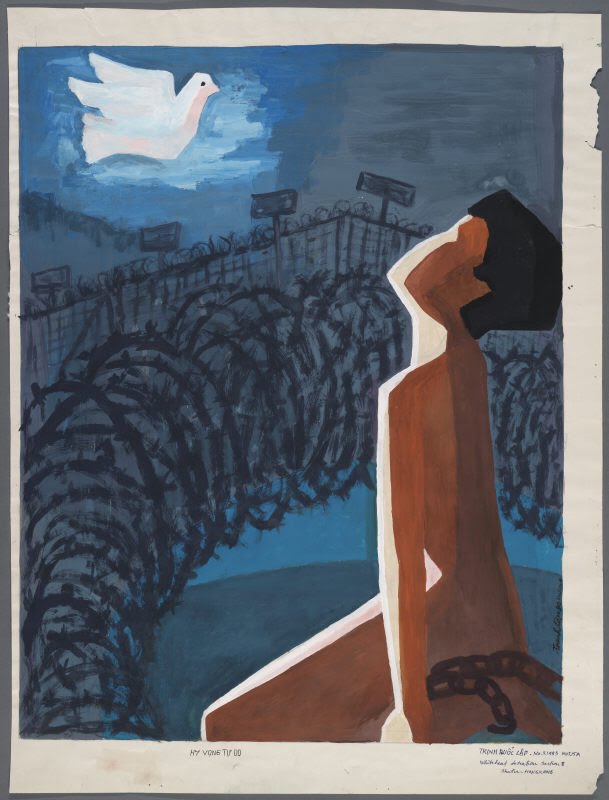
Figure 8.3 Hope of Freedom. Original by Trinh Quoc Lan, artist. Courtesy of Special Collections and Archives, University of California, Irvine Libraries. Project Ngoc Records on Southeast Asian Refugees (MS-SEA016).
My article on the artwork and literature from the Hong Kong Detention Camps after the Vietnamese boat people exodus is now out as a book chapter.

The chapter is: "Visions of resistance and survival from Hong Kong detention camps." It's chapter 8, pp. 99-115 in the book, Chinese/Vietnamese Diaspora: Revisiting the Boat People, edited by Yuk Wah Chan of City University of Hong Kong, from Routledge. It is the outgrowth of a workshop I was graced to attend at City University of Hong Kong back in October 2009.


The essay analyzes in detail just some of the artwork and literature from the refugee detention camps in Hong Kong, preserved in the Paul Tran and Project Ngoc Papers, originally given to University of California, Irvine's, Southeast Asian Archive, then under Anne Frank.

I write on the "barbed wire" theme and there are extended references to variations of the "chicken wing" metaphor. There is also a page on the Project Ngoc's "Proposal for Libraries in Refugee Camps." I also include figures on ethnic Chinese from Vietnam who were admitted to Hong Kong. The strange thing is when they arrive in the United States, their Chinese ethnicity is erased and they are treated as Vietnamese refugees. In total, almost half a million ethnic Chinese left Vietnam before September 1979, and at one point, some 60-70 percent of the boat people were ethnic Chinese from Vietnam, according to another contributor to the book, Ramses Amer. In my chapter, there are 25 citations (see below) including several to UC Irvine Libraries' Special Collections and Archives finding aids: Guide to the Paul Tran Files on Southeast Asian Refugees and Guide to the Project Ngoc Records.
Figure 8.4. Camp protesters. Original by Pham Tien Dung, artist. Courtesy of Special Collections and Archives, University of California, Irvine. Paul Tran Files (MS-SEA002).
Little Saigon community activist Paul Tran donated much of the materials from the Detention Centers to UC Irvine. The book notes: "When the material were given to Mr. Tran at the time, the authors' intentions were to get their voices heard in the outside world, and the materials were not meant to be sold commercially." Project Ngoc was a student group that sent UC Irvine students and other volunteers to help out the refugees in the camps. I hope this essay sparks further research interest in the collection.

Figure 8.6 Forced repatriation. Original by Tran Ngoc Dong, artist. Courtesy of Special Collections and Archives, University of California, Irvine Libraries. Paul Tran Files (MS-SEA002).
There is more meaty stuff in the volume, so hopefully your library will pick up the unfortunately pricey volume. I found myself learning a lot more about the topic, including that Cholon is misnamed as Saigon's Chinatown (read Li Tana's chapter). More information on the contents of the volume is
here:

Part I: Revisiting an era of Refugees and Boat People 1. Revisiting the Vietnamese Refugee Era: An Asian Perspective from Hong Kong - Yuk Wah Chan 2. Rethinking the Vietnamese Exodus: Hong Kong in Comparative Perspective - David W. Haines 3. The Boat People Crisis of 1978–1979 and the Hong Kong Experience Examined through the Ethnic Chinese Dimension - Ramses Amer 4. In Search of History: The Chinese in South Vietnam, 1945–1975 - Li Tana Part II: Hong Kong Vietnamese Boat People and Their Settlement 5. The Vietnamese Minority: Boatpeople Settlement in Hong Kong - Yuk Wah Chan And Terence C.T. Shum 6. Vietnamese Youth and Their Adaptation in Hong Kong - Ocean W. K. Chan 7. Thanh Loc- Hong Kong’s Refugee Screening System: From A Refugee Perspective - Peter Hansen 8. Visions of Resistance and Survival from Hong Kong Detention Camps - Daniel C. Tsang 9. Vietnamese Boat People in Hong Kong: Visual Images and Stories - Sophia Suk-Mun Law Part III: Hong Kong and Beyond 10. Sojourn in Hong Kong, Settlement in America: Experiences of Chinese-Vietnamese Refugees - Jonathan H.X. Lee 11. Dark Tourism, Diasporic Memory and Disappeared History: The Contested Meaning of the Former Indochinese Refugee Camp at Pulau Galang - Ashley Carruthers and Boitran Huynh-Beattie 12. The Repatriated – From Refugee Migration to Marriage Migration - Yuk Wah Chan 13. Epilogue - Yuk Wah Chan.

Another contributor visited UC Irvine and Little Saigon last year to talk about the detention camp artwork. Sophia Law, of Lingnam University in Hong Kong, was interviewed on Subversity then.

My thanks to Trinh Luu for helping with the translations.

To facilitate further research, here are the references in my article:

Amer, R. (1991) The Ethnic Vietnamese in Vietnam and Sino-Vietnamese relations,
Selangor: Forum.

Bale, C. (1990) 'Vietnamese boat People', in R.Y.C. Wong and lY.S. Cheng (eds), The
Other Hong Kong Report 1990, Hong Kong: Chinese University Press. p. 171.

Brook, R. (1996) 'Arbitrary detention of Vietnamese asylum seekers', Hong Kong Human
Rights Monitor Newsletter, June, www.hkhrm.org.hk/english/reports/enw/enw0696b.
htm (accessed 7 September 2009).

Fassi, L. (2010) 'Terra incognita: Luigi Fassi on the art of Danh Vo', Artforum, 4S(6):152- 59.

Fujita-Rony, D. and Frank, A. (2003) 'Archiving histories: The Southeast Asian Archive at University of California, Irvine', Amerasia Journal, 29(3): 155.

Guide to the Paul Tran files on Southeast Asian refugees (2003) MS-SEA02, Special
Collections and Archives, University of California, Irvine, Libraries, www.oac.cdlib.
org/findaid/ark:113030/tfSf59pltgl (accessed 6 September 2009).

Guide to the Project Ngoc Records (2003) MS-SEA016, Special Co\1ections and Archives,
University of California, Irvine, Libraries, www.oac.cdlib.org/findaid /ark:1130301
ktSz09pSpd?query=Project%20Ngoc (accessed 30 August 2009).

Hong Kong Government (1991) 'Ethnic origins of arrivals' 1991, in Monthly statistical
report (arrivals and departures) (March), SRD 704/ 1/1, located in Project Ngoc
collection, MS-SEAOI6, Box 1, Folder 42, Special Collections and Archives, University
of California, Irvine, Libraries.

Hunt, P.G. (1996) 'Dragons and chicken wings: the anomalies of the involvement of
Vietnamese refugees in crime in Hong Kong, 1989- 95', Master thesis, University of
Hong Kong, http://hub.hku.hk/handleI123456789/25752 (accessed 8 May 2010).

Knudsen, J.C. (1992) Chicken Wings: Refugee Stories from a Concrete Hell,
Bergen: Magnat Forlag.

--(2005) Capricious Worlds: Vietnamese Life Journeys, Lit Verlag, Muenster.
Lam, A. (2005), Perfume Dreams, Reflections on the Vietnamese Diaspora, Berkeley,
CA: Heyday Books.

Lam, L. (1994) 'Hong Kong Chinese: facing the political changes in 1997', in H.
Adelman (ed.), Legitimate and illegitimate Discrimination: New Issues in Migration,
Toronto: York Lanes Press, pp. 135- 52.

Law, S.S. (2008) 'Art in adversity-C.A.R.E. at Lingan University,' in Hong Kong Visual Arts Yearbook, Hong Kong: Chinese University of Hong Kong, pp. 143-63.

Nguyen, C. (2000) 'Hainan, Hong Kong, and Tuen Mun camp', in M.T. Cargill and J.Q.
Huynh (eds), Voices of Vietnamese Boat People: Nineteen Narratives of Escape and
Survival, Jefferson, NC: McFarland & Co., pp. 99- 106.

Project Ngoc (1988) The Forgotten People: Vietnamese Refugees in Hong Kong: A
Critical Report, Irvine, CA: The Project.

Robertson, G. (2002), 'Pam Baker: Hong Kong lawyer who fought for rights of
Vietnamese refugees', The Guardian, 27 April, www.guardian.co.uk/news/2002/
apr/27/guardianobituaries (accessed 7 September 2009).

Rumbaut, R.G. (2007) 'Vietnam' in M.C. Waters and R. Ueda (eds.) The New Americans:
A Guide to Immigration Since 1965, Cambridge, MA: Harvard University Press,
pp.652- 73.

Skeldon, R. (1994) 'Hong Kong's response to the Indochinese influx, 1975-93', The
Annals of the American Academy of Political and Social Science, 534.

Tran, D.T. (1990) Writers and Artists in Vietnamese Gulags, with Choe's Cartoons from
Vietnam, Idaho: Century Publishing House.

Trieu, M.M. (2008) 'Ethnic chameleons and the contexts of identity: A comparative
look at the dynamics of intra-national ethnic identity construction for 1.5 and second generation Chinese-Vietnamese and Vietnamese Americans,' PhD thesis, University of California, Irvine.

--(2009) Identity Formation among Chinese- Vietnamese Americans: Being, Becoming,
and Belonging, EI Paso, TX: LFB Scholarly Publishing.

U.S. General Accounting Office (1996) Vietnamese Asylum Seekers: Refugee Screening
Procedures under the Comprehensive Plan of Action, Washington, DC: The General
Accounting Office.

'Visions from Prison' (1995) in N. Morris and OJ Rothman (eds.), The Oxford History
of the Prison: The Practice of Punishment in Western Society, New York, NY: Oxford
University Press, 8 pages of unnumbered plates between pages 274 and 275.

Zinoman, P. (2001) 'Reading revolutionary prison memoirs', in H.T.H Tai (ed.), The Country of Memory: Remaking the Past in Late Socialist Vietnam, Berkeley, CA: University of California Press, pp. 21-45.

Wednesday, September 7, 2011

Remembering Bob Jones


Updated 10 September: Prayers will be said for Bob Jones at St. Anselm's Cross Cultural Community Center [correction: NOT today] next Saturday September 17 at 5 pm, according to Nguoi Viet [Correction: which gave the wrong date. The correct info is posted [see image below] at the center's door.] Address: 11277 Garden Grove Blvd [at Euclid] Garden Grove, CA 92843. See also video of dedication of Bob Jones Building in Rochester MN earlier this year where daughter Kieu Oanh spoke.

Bob Jones, a former American diplomat in Saigon, and longtime community activist most recently in Little Saigon, passed away after a long illness. He was a friend and believer in archiving the histories of diverse immigrants, especially Vietnamese, having mastered Vietnamese during his time in Saigon, where he befriended Yen Do, who would later found Nguoi Viet Daily News in Westminster, California, frequenting book stalls in Saigon with him in quest of Vietnamese literature, in the war years, he once told me.

I had a long phone conversation with him a few months ago, at a time when he was being treated for colon cancer, when we discussed his being a guest on my show to reflect on his full life. Unfortunately, it never came to be. I regret not capturing for posterity his reflections on his life's work. (Perhaps the NSA has the audio of that phone conversation that lasted over an hour.) In Saigon, he collected a massive amount of Vietnamese literature and art, which he shipped to the United States. I hope that collection finds a good home. His smaller collection of gay community publications went from a storage locker in Orange County to a community archive in the Midwest, he told me.

He also served actively for many years on the advisory board of UC Irvine's Southeast Asian Archive at UCI Libraries, giving his time, effort and wisdom to the collection here. I remember him as a warm friend, living in a small apartment in the heart of Little Saigon, who would regularly turn up at UCI Libraries with latest issues of local community magazines and newspapers he had picked up, for the archive. He was a true community activist who gave himself fully to the community, and worked to make sure the written record was not erased. His colleagues at St. Anselm's Cross Cultural Community Center plan a local memorial event, forthcoming. - Daniel C. Tsang.

An obituary released today by his daughter, Kieu Oanh follows.

________________________________________

OBITUARY

Robert R. “Bob” Jones III, 69, a longtime resident of Rochester, died peacefully at his home on Monday (Sept. 5, 2011) from complications of colon cancer.

Bob was born May 25, 1942 to Dr. Robert and Dorothy (Stewart) Jones at Jersey City Medical Center, New Jersey. He moved with his family to Rochester when his father, an Army doctor, joined the Mayo Clinic in the 1950s. Bob graduated from John Marshall High School in 1960, attended Lake Forest College and the University of Minnesota, majoring in International Relations. During the summers of his college years, Bob held jobs ranging from working at a lodge high in the Colorado Rockies, to serving inner-city mothers and children on a hospital ship anchored in New York harbor.

During the Vietnam War, Bob served in the U.S. Army at the Presidio of San Francisco and at the U.S. Embassy in Saigon. Following his discharge, he was asked to continue on the Embassy staff where he remained from 1966 to 1975, becoming known as the “institutional memory” of that era. During that time, he helped design and monitor for Vietnam what was, at the time, the world’s only comprehensive data processing system for reporting political, economic and security conditions at a nation’s “grass roots” level.

Bob fell in love with Vietnamese history and culture, learning to speak the language fluently and was often sought after by visiting diplomats and journalists who relied on him for information and insight into Vietnamese affairs.

Upon his return to Rochester, he was asked by the Bishop of the Diocese of Winona to establish a program under the auspices of Catholic Charities to coordinate the resettlement of the newly arriving refugees from Vietnam, Laos and Cambodia. For the following 15 years, he worked tirelessly to develop sponsorship opportunities and supportive programs for refugees arriving in the Diocese from around the world.

During his years as Resettlement Director, he was also active at the state level as founder and longtime Chair of the Minnesota Consortium of Refugee Agencies.
In 1991, Bob was called to Washington, DC, to receive the John McCarthy medal, the highest award bestowed annually by the US Conference of Catholic Bishops for service to the world’s refugees.

Bob also believed strongly in the need to empower refugees to develop and lead self-help programs and to plan and coordinate cultural events. To achieve that goal, he brought together refugees and Rochester community leaders to raise the necessary support and funding to found a new agency, the Inter-Cultural Mutual Assistance Association (IMAA). The IMAA has become over the years a national model, and in March 2011 the building was dedicated as the Robert Jones III building.

Bob was also active in civic affairs. He helped found the Rochester International Association (RIA) and regularly assisted with its annual Rochester World Festival. A civic highlight for Bob was his selection by then Rochester Mayor Chuck Hazama to be a member of a team of city leaders, which worked tirelessly to develop a presentation, which they took to Houston, Texas to compete for and to bring back to Rochester the much-coveted “All-American City” designation. He also served one year as Interim Director of Rochester’s newly emerging Habitat for Humanity Program.

From 1998 to 2008 he moved to Westminster, Ca. where he taught citizenship classes in the area of Orange County, California, known as “Little Saigon.” At St. Anselm’s Cross-Cultural Community Center, Bob developed and taught classes which graduated hundreds of new US citizens. He was widely and fondly known in the community as “Thay” (teacher) Bob. He returned to Rochester in 2008.

He was a member of the Unitarian Universalist Church of Rochester, the Institute of Vietnamese Studies and the Association for Asian Studies. He also served on the Boards of the National Association of Vietnamese-American Social Agencies and the Southeast Asian Archive at the University of California-Irvine.

His family would like to express their deepest appreciation to the Mayo Clinic doctors and nurses who cared for Bob during his illness and Lynn Nomann, RN, with Saint Jude Hospice in his final days.

He is survived by his daughter - Kieu -Oanh (John McInnis) of Madison, WI, his mother Dorothy of Wabasha, MN, his sister Sharon (Frank) Stewart of Goleta, CA, brother, Dr. Roger (Cheryl) Jones of Elko, NV and many nieces and nephews. He was preceded in death by his father and his sister Linda Brandolino.

A funeral service will be held at 5:00 P.M. on Friday (Sept. 9, 2011) at Christ United Methodist Church , 400 5th Ave. S.W. , in Rochester, with the Rev. Dr. Carol Hepokoski of the Unitarian Universalist Church in Rochester, officiating. Friends may call from 3 to 5:00 P.M. on Friday at the church. A private family burial will take place on Saturday at Riverside Cemetery in Wabasha. The family asks that memorials be made to IMMA, Minnesota Public Radio or Saint Jude Hospice, Rochester in lieu of flowers. Arrangements are with Griffin-Gray F.H, in Stewartville,Mn.