Monday, April 18, 2011

VIFF Filmmakers' Panel Discussion: Expanding the Audience Base

To listen to the podcast of this program, click
on:

The 2011 Vietnamese International Film Festival ended its exciting two week run last night with a daring, sexually explicit film, "Bi, Don't Be Afraid" directed by Phan Dang Di. The film, set in a hot and steamy Hanoi summer won the festival's Grand Jury prize for Best Film. Viewers in the audience saw a version that was more sexually explicit than that released in Vietnam, with masturbation (female and male), frontal urination (by a male student) and various scenes of heterosexual intercourse.

For this evening's edition of Subversity, we can't bring you that film, but will instead offer audio of the 10 April 2011 Filmmakers' Panel Discussion on "Expanding the Audience Base" that took place at UC Irvine.

Panelists were: Anderson Le, director of programming at the Hawaii International Film Festival; Ann Le, with international division of Universal Pictures; Charlie Nguyen, director of The Rebel; Fool for Love; James Nguyen, director/writer, Birdemic: Shock and Terror; Jenni Trang Le, Assistant Director, Bi, Don't Be Afraid, and of Clash; Khoa Do, Director/Writer, Footy Legends, Mother Fish; Le Thanh Son, director/writer, Clash, and Nguyen Nu Nhu Khue, producer with HK Films in Vietnam.

The program airs this evening from 5-6 p.m. on KUCI, 88.9 FM in Orange County, Calif., and is simulcast via http://kuci.org. Podcast to be posted later.

Monday, April 11, 2011

Filmmaker with Conscience Khoa Do; Hazards of Nail Salons

To listen to the podcast of this program, click
on:
Director Khoa Do embraced by a fan after his film screened at VIFF 2011. Photography &c Daniel C. Tsang 2011

He's a Viet Kieu filmmaker with conscience. Hailing from Australia, and emerging as one of the most exciting new filmmakers from the Vietnamese diaspora, Khoa Do presented "Mother Fish," his dramatic and creative take on the boat people's exodus to the West at the 5th Vietnamese International Film Festival ongoing at various venues in Southern California, including UC Irvine. As he discusses in the interview, he made this film to counter anti-refugee prejudice in Australia against a current wave of boat people from more current wars.

We talk with this award-winning director who charmed audiences at the last VIFF with his Footy Legends, about a multi-ethnic sports team, with a strong background in community service as a volunteer in a community-based organization in Sydney, where he made an earlier documentary, Finished People, about homeless people on the streets.

Khoa was named the 2011 VIFF Spotlight Award winner Saturday at a special event co-sponsored by Vietnamese American Community Ambassadors and the UCI Libraries Southeast Asian Archive prior to that evening's showing of Mother Fish.


The festival continues at UCLA, Bowers Museum (free to high school students) and UC Irvine. Among the films is "Touch," directed by Minh Duc Nguyen, a feature film about romantic liaisons among Vietnamese nail salon workers and their clients. It screens Saturday, 16 April 2011 at 7:30 p.m. HIB (Humanities Instructional Building) 100 on the UCI Campus.

For the second half of Subversity, we air Making Contact's report on the Toxic Truth about Nail Salons. It focuses on the health effects of prolonged chemical exposure on the salon workers and the move toward "greener" salons.

Also showing at VIFF is director Nguyen-Vo Nhiem Minh's second Vietnam production, Don't Look Back, a ghost story that is a takeoff on the Orpheus myth. Nguyen-Vo, who was last on Subversity discussing his "Buffalo Boy", is a scientist turned Vietnam filmmaker. Don't Look Back screens the same day, Saturday 16 April 2011 at 4 pm at HG (Humanities Gateway) 1070 on the UCI campus.

Subversity airs this evening from 5-6 p.m. on KUCI, 88.9 FM in Orange County, and is simulcast via kuci.org.

Monday, March 28, 2011

Yemeni Regime Collapsing? Who are the Protesters? And What Comes After?

To listen to the podcast of this program, click
on:

February 3, 2011 protest poster.

With more countries in the Middle East erupting in protest, we return again to a focus on one of those, Yemen, whose president seems tottering on the verge of quitting. Who are the protesters? And were the pro-U.S. regime to fall, what comes after?

On this evening's edition of Subversity, a KUCI public affairs program, we talk with William Picard of the Yemen Peace Project again about those questions and analyze recent developments, some horrific, some encouraging.

For your information, the Yemen Peace Project has posted a link to donations on its web site, with a plug to: "Support Yemen’s Peaceful Protesters:
Hundreds of thousands of brave Yemeni citizens are risking their lives and livelihoods to make their country a better place. Help them by supporting those that provide urgent medical care to protesters injured by state security forces."

William Picard is a political and historical researcher and analyst based here in Orange County. He has spent a decade studying Southwest Asia, with a particular focus on the modern history and current affairs of Yemen. He is a graduate of the University of Pennsylvania, where he studied Arabic, Persian, and Pashto, and completed a double major in Modern Middle East Studies and Southwest Asian Conflict Studies. In late 2009 he helped found the Yemen Peace Project (YPP) with Dana, a peace advocacy organization that seeks to educate the American public about Yemen, advocate for peaceful and constructive foreign policy, and facilitate communication between Yemenis and Americans. He directs the YPP’s research and public education efforts, manages the organization’s Twitter activity, and writes frequently for the Directors’ Blog.

Picard was previously on Subversity February 7, 2011 with UCI graduate student Dana Moss, also of Yemen Peace Project. Moss also appeared subsequently a week later on Subversity.

Picard is interviewed by Subversity Show host Daniel C. Tsang. The show airs from 5-6 p.m. today on March 28, 2011 on KUCI, 88.9 FM in Orange County, California, and is simulcast via kuci.org. Podcasts will be posted here shortly.

Monday, March 21, 2011

Egyptian Women; Avoiding Another Korean War

During this spring break at UC Irvine, Subversity takes a break of sorts and airs two programs from Making Contact, from the National Radio Project.

Egyptian Women on the Frontlines of Change takes a look at the most recent Egyptian Revolution and the role of women in political change, in the context of the history of women's activism there.

As the US and its allies drop bombs on another country, we air another Making Contact program - that on Avoiding a Korean War.

The links bring more information as as well audio links to those two programs.

The Subversity show airs on KUCI, 88.9 FM in Orange County, from 5-6 p.m. Pacific time, today, 21 March 2011.

Monday, March 14, 2011

Perils of Natural Gas Drilling. Also: WikiLeaks, Free Speech & Future of the Internet

On the 14 March 2011 edition of Subversity, a KUCI public affairs program, we air two dispatches from the National Radio Project's
Making Contact
series.


In the wake of the horrific twin disasters in Japan, there is growing concern about the efficacy of nuclear power. The Making Contact
program in our first half hour looks at an another energy source, natural gas, and the perils of that resource: Still Fracking: The Perils of Natural Gas Drilling


In our second half hour, we will focus on another topic eclipsed by last Friday's events in Japan. Making Contact has released this
program, WikiLeaks, Free Speech & The Future of the
Internet
.


Our thanks to National Radio Project for their work.


Today's program airs from 5-6 p.m. on KUCI, 88.9 FM in Orange County, California.

Tuesday, March 8, 2011

Treat Protests as "Teachable Moments"! Sixty-two UCI Faculty Urge Chancellor Drake to Tell DA to Drop Criminal Charges

Non-violent and loud sit-in outside UCI Chancellor's Office 24 February 2010. Photo © Daniel C. Tsang 2010.
Sixty-two UC Irvine faculty members earlier today urged UCI Chancellor Michael Drake and the Chair of the Academic Senate, Prof. Alan Barbour, to publicly ask Orange County District Attorney Tony Rackauckas "to drop the criminal charges" against the UCI students involved in the "civil disobedience" outside the Drake's Office on February 24 last year, suggesting that "political action" can better be regulated by campus rather than "external" authorities.

The signatories to the three-page letter, dated today and delivered this morning to the Chancellor's office, notably include four Department Heads: Jared Sexton, Chair of African American Studies, Jennifer Terry, Chair of Women's Studies, Susan Jarratt, Chair of Comparative Literature, and Jim Lee, Chair of Asian American Studies. It also includes two Distinguished Professors, Ngugi wa Thiong'o, of English and Comparative Literature, and Etienne Balibar, of Humanities, French and Italian, and Comparative Literature. One-third of the signatories are Full Professors, the rest mainly Associate Professors.

"We ask that the university return to an environment engaged in teaching and learning. Student activism and campus debate should be treated as teachable moments, lead to open discussions about the meaning of civil disobedience, the history of social movements, and the wide variety of political discourse within our community," the letter urges the Chancellor.

It concludes: "These and other actions can affirm the mission of the university as one of teaching, learning, supporting a wide range of ideas, opinions, and political actions."

There were actually altogether 19 defendants in the case, not all of whom are UCI students, with many active in the UCI Worker-Student Alliance on campus. The protest outside the Chancellor's office had focused on poor labor conditions facing outsourced workers at UCI.

Today's letter comes in the wake of another, signed by 100 UCI faculty members, urging the Orange County District Attorney to drop criminal charges against the 11 Muslim students involved in protesting the talk given last year on campus by the Israeli Ambassador, Michael Oren. That letter was heavily promoted by the UCI Communications Office and posted on the UCI web site as a featured story.
UCI Police begin the arrests of the protesters outside the Chancellor's Office. Photo © Daniel C. Tsang 24 February 2010.

The Full Text of the Letter and Signatories Follow:

UNIVERSITY OF CALIFORNIA, IRVINE

Tuesday, March 8, 2011

Dear Chancellor Michael Drake:

CC: Michael R. Gottfredson, Executive Vice Chancellor and Provost
Dr. Rameen Talesh, Dean of Students and Assistant Vice Chancellor, Student Affairs
Edgar Dormitorio, Director, Student Conduct and Assistant Dean of Students
Thomas A. Parham, Ph.D., Interim Vice Chancellor Student Affairs
Alan Barbour, PhD., Chair, Academic Senate

We write to express our concern about the current campus climate regarding student activism, political debate, and social action.

We have been dismayed to learn that the Orange County District Attorney has criminally charged students who engaged in an organized act of civil disobedience on February 24, 2010 outside of the Chancellor’s office in Aldrich Hall. Taking a cue from a long history of activism on University of California campuses, the student coalition had organized a protest to call attention to a variety of pertinent issues on our campus including tuition and fee increases and a hostile environment for students of color. While two students barricaded doors and engaged in other actions that we may not support, political action on campus should be regulated by the university and not external authorities.

Under the purview of the Student Conduct Director of the Office of the Dean of Students, students were placed on academic probation for a year, required to complete 30 hours of community service, a five-page reflection paper on community service hours, and a ten-page paper on the First Amendment. It is our understanding that students have completed or are in the process of completing this punishment set by the university.

On December 9, 2010, these UCI students were charged by the Orange County District Attorney for disorderly conduct. It is our position that this criminal prosecution is incommensurate with the student actions: There was no bodily harm and no property destruction of any kind. The UCI police, not the protesting students, called for an evacuation of Aldrich Hall. Unlike similar incidents, the student protestors were arrested without the usual intervention of the Student Conduct unit. Lastly, it is striking that the criminal charges were filed ten months following the event, two months before the statute of limitation, and on the last day of the quarter.

• We ask that the university explain its role in the Orange County District Attorney proceeding with criminal charges when usually these acts of student civil disobedience have been handled internally.
• We ask that the Chancellor and the Chair of the Academic Senate issue a public statement asking the Orange County District Attorney to drop the criminal charges.
• We ask that the university return to an environment engaged in teaching and learning. Student activism and campus debate should be treated as teachable moments, lead to open discussions about the meaning of civil disobedience, the history of social movements, and the wide variety of political discourse within our community.

These and other actions can affirm the mission of the university as one of teaching, learning, and supporting a wide range of ideas, opinions, and political actions.

Sincerely,

Jean-Daniel Saphores, Associate Professor, Civil & Environmental Engineering
Paul Dourish, Professor, Informatics
Jared Sexton, Associate Professor & Chair, African American Studies
Scott Bollens, Professor, Endowed Professor in Peace and Intl Cooperation
Francesca Polletta, Professor, Sociology
Lilith Mahmud, Assistant Professor, Women's Studies
Mike Burton, Emeritus Professor, Anthropology
Jennifer Terry, Associate Professor and Chair, Women's Studies
Catherine Liu, Associate Professor, Film and Media Studies
Tiffany Willoughby-Herard, Assistant Professor, African American Studies
Catherine L. Benamou, Associate Professor, Film and Media Studies
Frank Cancian, Emeritus Professor of Anthropology
Rodrigo Lazo, Associate Professor, Department of English
Heidi Tinsman, Associate Professor, History
Cynthia Feliciano, Associate Professor, Chicano/Latino Studies and Sociology
Annette Schlichter, Associate Professor, Comparative Literature
Eyal Amiran, Associate Professor, Comparative Literature and FMS
Jessica Millward, Assistant Professor, History
Etienne Balibar, Distinguished Professor of Humanities, French and Italian,
Comparative Literature
Victoria Bernal, Associate Professor, Anthropology
Tom Boellstorff, Professor, Anthropology
Jeanne Scheper, Assistant Professor, Women's Studies
Ellen S. Burt, Professor, French and Comparative Literature
Roxanne Varzi, Associate Professor, Anthropology and Film
Keith M. Murphy, Assistant Professor, Anthropology
Robert Garfias, Professor, Anthropology
Julia Elyachar, Assistant Professor, Anthropology
Kris Peterson, Assistant Professor, Anthropology
Steven Topik, Professor, History
Michael Montoya, Associate Professor, Anthropology, Chicano and Latino Studies,
Public Health, Nursing Science
Elizabeth M. Guthrie, Senior Lecturer, SOE (Retired), French
Claire Jean Kim, Associate Professor, Political Science and Asian American Studies
David A. Smith, Professor, Sociology
Luis F. Aviles, Associate Professor, Spanish and Portuguese
Cecelia Lynch, Professor, Political Science
Elizabeth Allen, Associate Professor, English
Daniel M. Gross, Associate Professor and Director of Composition, English
Rebecca Davis, Assistant Professor, English
Deborah Vargas, Assistant Professor, Chicano/Latino Studies
Santiago Morales, Assistant Professor, Spanish and Portuguese
Ngugi wa Thiong'o, Distinguished Professor, English and Comparative Literature
Carolyn Boyd, Professor Emeritus, History
Susan Jarratt, Professor and Chair, Comparative Literature
Karen Leonard, Professor, Anthropology
Rajagopalan Radhakrishnan, Professor, English and Comparative Literature
Irene Tucker, Associate Professor, English
Adriana Johnson, Associate Professor, Comparative Literature
Ivette N. Hernandez-Torres, Associate Professor, Spanish and Portuguese
Charles Chubb, Professor, Cognitive Sciences
James Fujii, Associate Professor, East Asian Languages and Literatures
Dina al-Kassim, Associate Professor, Comparative Literature
Gilbert G. Gonzalez, Professor Emeritus, Chicano Latino Studies
Jon Wiener, Professor, History
Kavita Philip, Associate Professor, Women's Studies
Frank B. Wilderson, III, Associate Professor, Director, Humanities & the Arts,
Drama & African American Studies
Alice Fahs, Associate Professor, History
Lynn Mally, Professor, History
Raul Fernandez, Professor, Chicano Latino Studies/Social Sciences
Laura J. Mitchell, Associate Professor and Vice Chair, History
Arlene R. Keizer, Associate Professor of English and African American Studies,
Director, PhD Program in Culture and Theory
Jim Lee, Chair, Asian American Studies
Rachel Sarah O'Toole, Assistant Professor, History

Monday, March 7, 2011

Subversity Host Reflects on Activism Off and On the Air

To listen to the podcast of this program, click
on:
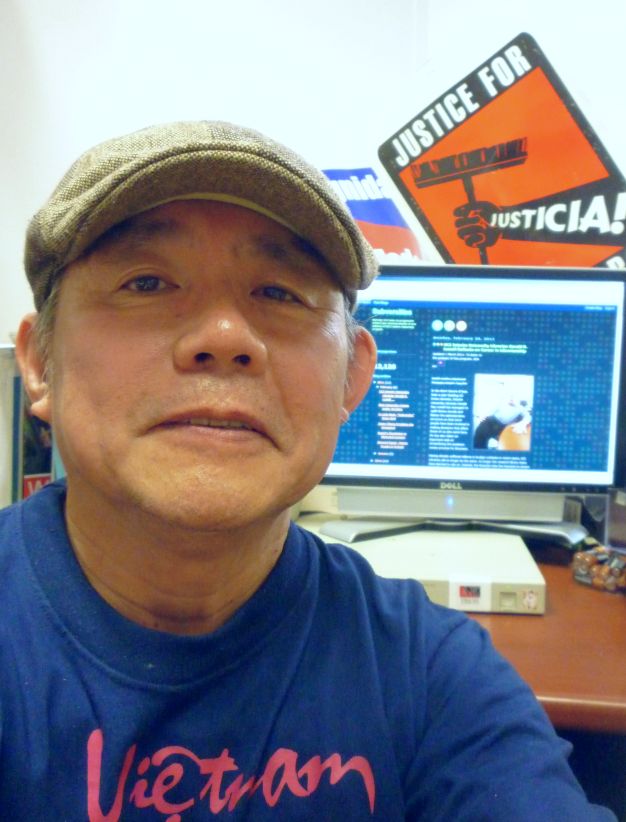
Self-portrait in the UCI office, taken right after taping of the interview 4 March 2011 for East 306. Photo © Daniel C. Tsang, 2011.

An enterprising Asian Studies undergraduate class at McGill University in Montreal has an intriguing mission: Create an experimental radio program to document social change in Asia and the Asian diaspora by interviewing activists, scholars and the like.

So I was honored to be one of those interviewed in the project, East 306, whose blog posts audio of past interviewees. Its post today profiles Subversity and my work on and beyond the show.

The back story: The class is co-taught by the superlative Adrienne Hurley, a Japanese Studies doctoral graduate from UC Irvine. The first scholar interviewed by East 306's team of earnest students was another Japanese Studies Ph.D from UCI, Kota Inoue, who is now teaching at my alma mater (see below). The interview with me was conducted using the facilities of a pioneering radio radio station at McGill, CKUT, which is expected to also air this program.

Here's what the students wrote in generously profiling me (taken from their blog) [hyperlinks revised]:

Since the program first aired in 1993, Daniel Tsang has been the host of Subversity on KUCI, the student and community radio station at the University of California, Irvine. Every Monday at 5pm (8pm in Montréal), he airs critical commentary and conducts in-depth interviews for this internationally recognized program that serves as an open seminar via radio. You can listen live via the KUCI website and browse past interviews and topics here (where you’ll also find a web-exclusive archive). On Subversity, Dan makes available to the masses the voices and ideas of activists, librarians, dissidents, and scholars, including Prof. Dylan Rodriguez, with whom Dan spoke shortly after the last U.S. presidential election. He has interviewed the actor Dustin Nguyen and the director Stanley Kwan, and he has covered a wide array of topics ranging from breast cancer (in a memorial tribute to UC Irvine graduate student Robyn Shikiya) to the ideological screening out of radicals in graduate and professional schools (in an interview with Jeffrey Schmidt).

Dan Tsang is also Data Librarian and Bibliographer in Asian American Studies, Political Science, and Economics at the University of California, Irvine, where he organized the Immigrant Lives Exhibit to debunk ‘The OC’ TV image of Orange County. He maintains Subject and Course Guides in fields such as Asian American Studies, Political Science, Economics, and the Social Sciences. He earned his B.A. in Government from the University of Redlands, where Professor Kota Inoue (interviewed in our very first podcast) currently teaches. Dan Tsang went on to earn two graduate degrees at the University of Michigan, an M.A. in Political Science and an M.L.S. in Library Science. As a journalist, Dan has authored numerous articles and opinion pieces, as well as scholarly publications, which you can see listed here. In today’s podcast, Dan mentions Elaine Black Yoneda, a white woman who joined her Japanese American husband in the internment camp. Dan’s biographical entry on her is the last entry in Notable American Women: A Biographical Dictionary Completing the Twentieth Century (Cambridge, MA: Belknap Press, 2004), Vol. 5, 707-709.

Dan edited the magazine Gay Insurgent in Philadelphia in the early 1980s. He was a Fulbright research scholar at the National Academy of Social Sciences in Hanoi, Vietnam in 2003-2004, and contributes greatly to our collective survival as a radical archivist, data librarian, indexer, and bibliographer. He also sued the CIA for spying on him and won. (He discusses this case in today’s podcast.)

Samantha Chrisanthus, who studies Political Science and Women’s Studies at McGill, interviews Dan Tsang about his work in libraries and radio stations, as well as his efforts to document and archive injustice and harm. Sam begins by asking Dan how Subversity started and what led him to radio. In this lively and very informative interview, Dan discusses topics such as how to document police harassment and abuse, the chilling effects of the current case of the Irvine 11 on student movements and student activism, and why we need data liberation movements and radical archiving. Dan also talks about obtaining FBI files on dead activists (and philosophers) and why we should think about preserving our own archives while we are still here and making them.


As host of Subversity I usually get to interview activists; given that they have turned the tables on me, let me return the favor and air the interview on KUCI as well.

The show with this free-wheeling interview by Sam Chrisanthus of myself airs this evening from 5-6 p.m. on KUCI, 88.9 FM in Orange County, California, and is simulcast via kuci.org.

Monday, February 28, 2011

UCI Interim University Librarian Gerald R. Lowell Reflects on Career in Librarianship

Updated 1 March 2011: To listen to
the podcast of this program, click
on:

Gerald R. Lowell in a relaxed mood. Photography © Daniel C. Tsang 2011
In his short tenure of less than a year heading UC Irvine Libraries, Interim University Librarian Gerald Ray Lowell has managed to uplift library morale and flatten the administrative structure so that more people have been involved in making decisions that affect those of us who work here. He has also taken an important stab at streamlining the academic review process for librarians.

Having already suffered millions in budget cutbacks in recent years, UCI Libraries will no longer be the same, no longer the research library many have learned to rely on. Instead, the financial crisis has imposed so severe a toll that in future, research collections will be smaller, and the focus will be on service rather than building up in-depth collections. The UCI administration, in applying its budget-slashing formulae, has startlingly taken to considering the libraries as an administrative unit on campus, rather than an academic one.

This interview with Gerald Lowell -- Jerry as he was known to us -- is being aired today, his last day of work at UC Irvine. He looks back at his extensive career in librarianship and reflects on his life's work.

He explains why he came over the to the libraries from the Arts School (where he had been an assistant dean) after he had already headed the research libraries at UC Berkeley and UC San Diego, and offers his take on the future of academic libraries, including UCI's.

He soon heads off with his partner Mitchell to Spain, where they look forward to a well-deserved retirement far away from the volatile political rhetoric emanating from the airwaves state-side.

To listen to the interview, where Jerry Lowell talks with Subversity host Daniel C. Tsang, tune in to KUCI, 88.9 FM at 5 p.m. this evening, or listen online via kuci.org. Subversity is a weekly KUCI public affairs show. A podcast will be posted later on this site.

Sunday, February 27, 2011

New University Comes Under Scrutiny

Front page of New University scoop.
In scooping other media with the months-old story of UC Student Regent Jesse Cheng's arrest -- and subsequent refusal of prosecutors to file charges -- for attempted sexual battery and attempted rape, did the UCI student-run newspaper, New University rush the article into print? I ask this even though I realize that the Student Regent declined to speak on the record with the paper initially.

In almost two weeks since the story, "Student Regent Under Investigation" written by managing editor Traci Garling Lee and editor in chief David Gao [The names are reversed in the print edition], originally ran, it seems abundantly clear that the New University was ill-equipped to handle such a news story, just as it mishandled, just several weeks earlier, a news account, which it similarly posted prominently on its front page, relating to a new development in UCI's decade-plus-old fertility scandal, of which more later in this blog entry.

Even before a few days had passed, critics of the New University coverage had chimed in online, suggesting on its web site that it had been "used" by Jesse Cheng's former partner, the anonymous Filipina American UCLA law student who went to the Irvine police with the initial allegations against Cheng, a popular UCI fifth-year Asian American studies major who still had months left in his tenure as an appointed UC Student Regent.

Suzanne Kordi engaged in a series of online exchanges with Current Student, with Suzanne, who wanted to submit a piece about Jesse Cheng's innocence and also on the Egyptian revolution, commenting 15 February 2011: "Apparently degrading someone’s reputation is more important than the Egyptian Revolution?" She also wrote: "Also, I don’t understand why the 'series of e-mails' was maliciously turned over the the New University. If this were not solely intended to assault someone’s integrity, I would have turned the details over to a legitimate news source."

After Suzanne Kordi questioned the campus paper's journalistic ethics and gave a link to the Society of Professional Journalists ethics code, Current Student responded that same evening, 15 February 2011: "are you, a non-journalist, using your untrained google web skillz [sic] to inquire into the reporters reporting ethics? did you know that UCI LJ majors take a class, taught by a Pulitzer Prize winning journalist, on this exact specific topic before they are even allowed to practice their major? and did you also know that UCI LJ majors have, to some extent, this guy (http://www.law.uci.edu/faculty/profile_h_weinstein.html) for reference, among many others? I mean, the reporter probably conferred with at least one of them, at least once, before publishing this story, right?" I wouldn't have made that assumption. The reference in Current Student's comment is to Pulitzer Prize-winning former Los Angles Times legal affairs journalist, Henry Weinstein, who teaches in the UCI Law School and has a joint appointment in Literary Journalism.

On 16 February 2011, "Observer B" commented in part: "I can understand why he wouldn’t speak to the New U. Just last month, it ran another front-page article calling someone a 'criminal' who had not yet been brought to trial on the charges. (The writing is awful, too, mentioning 'unethical crimes,' as opposed to the ethical ones, I guess.)"

Observer B ended: "I think this poor reporting is a function of long-term underfunding (deliberate on the part of administration to prevent good reporting from happening), the weekly nature of the New U, which disallows follow-up reporting and related stories, and the lack of a journalism program at UCI. Literary Journalism doesn’t necessarily count. Isn’t the 'literary' part about being able to make stuff up and assertively inject the writer’s subjective take? Good stuff for some media, but for a newspaper article that could erroneously destroy someone’s career? Not so much."

"LJ Defender" shot back 18 February 2011: "Literary Journalism is not about being able to “make stuff up and assertively inject the writer’s subjective take” … it is about conveying the facts from a creative angle. That doesn’t mean it gives license to fabricate, NO form of journalism would allow that. The truth is still the truth, no matter how you approach it, whether it is through the inverted pyramid form of straight reporting or the magnifying glass of literary journalism. Just clarifying. But I do agree with you on the New U’s history of poor reporting and even poorer writing. Publishing this article was premature and insensitive given the lack of evidence."

A "Former Journalist" also commented online, suggesting that a class in journalism does not a journalist make. He wrote 16 February 2011: "As a former journalist, I can tell you that taking a class about journalistic ethics is not quite the same as practicing journalistic ethics. The latter often comes from years of experience or the benefit of an editor with years of experience, neither of which is evident at the New U. And if your Pulitzer Prize-winning professor hasn’t mentioned it yet, reporters rarely have the luxury of all the facts. That’s simply part of the job and why practicing journalists are obligated to exercise better judgment than the New U has shown here."

He ended: "There may be a good chance that the New U has allowed itself to be used. And your snide response to Suzanne Kordi suggests you have a bit of growing up to do. Not a good quality for a student journalist whose article may destroy someone’s reputation without any legal charges being filed."

Reacting to feedback online, he added: "The New U has the right to report almost anything. That’s not the issue. The question is whether they should and when they should. As you suggest, I don’t know Ms. Lee or Mr. Gao’s intent. However, the lede refers to a victim, not an alleged victim, and the second graf says Cheng does not 'currently' face charges. This implies he may face charges. Precision counts. Among other things, this could be why some readers perceive bias. Covering one’s bases, doing due diligence and seeking counsel are the minimum for reporting a story like this. Reporters don’t get extra credit for that."

Indeed, the New University does not have a formal structure of of built-in journalism advisers, unlike typical student newspapers.

Most telling is the fact that two weeks after the campus paper broke the story, neither of the two mainstream newspapers covering Orange County, the Orange County Register and the Los Angeles Times has yet to file a single story on it, not even a blog entry. It is apparent that, despite the arrest, the fact that the Orange County District Attorney's office failed to press charges means the story -- months old -- is one that mainstream journalists would prefer not to bring to print, no doubt in fairness to the accused: It's a non-story. (It's another matter whether it should cover the growing split in the activist community over Cheng.)

Even the alternative OC Weekly, for which I freelanced under its founding editor, Will Swaim, a graduate of UCI's history department, in its first print story after running blog updates on the New University revelations, sought to cast the story in a way that can only be seen as sympathetic to Cheng, and countering the New University's one-sided initial account.

In a blog-turned-into print story, UCI's Ex Scandal, written by Matt Coker, who used to edit my stories, a sub-head declared "student regent Jesse Cheng fights off ex-girlfriend's attempted rape allegation". The ambiguous reference to an ex-scandal could be read two ways: As a scandal involving Cheng (the girlfriend's ex), or a scandal involving his ex, the former girlfriend.

Even the New University, in reporting Cheng's denial of his ex's story, must have learned from the online feedback, giving this heading to its story, "Student Regent Speaks on the Record, Responds to Allegations," by David Gao and Traci Garling Lee. In addition to correctly calling the ex girlfriend's accusations "allegations", it also called her an "alleged victim" -- something it most famously failed to do in the story it ran with initially.

Other UC campus papers have also chimed in, including UC San Diego's The Guardian, which pointed out in its 24 February 2011 story by Jonathan Kaslow headlined "Battery Charges Dropped Against Student Regent," that the "New University received criticism from students for using condemnatory language against Cheng while only citing the anonymous source, Laya. Students expressed doubts about the accuracy of New University’s Feb. 16 “Student Regent Under Investigation” article. 'Personally to me, NewU has often inaccurately reported certain events (to some extent), especially this event,' one comment read. Some also resented the article’s insinuation that Cheng was not charged due to his status."

Is there any doubt that New University lacks the experience and knowledge of journalistic standards when covering a crime story, that other campus newspapers, such as the Guardian, have exhibited?

If you want further proof, I offer this exchange of emails with me and New University editors that I initiated last month, before the revelations about Cheng came out.

I was appalled that in its 18 January 2011 edition, the paper ran a front-page story by UCI student Shruti Shantharam on one-time UCI faculty superstar hire Dr. Ricardo Asch, a key figure from the 1990s fertility scandal, who had been located in Mexico and was in the process of being extradited back to Santa Ana to face federal charges. Unlike other mainstream coverage, the New University, contrary to all journalistic standards, depicted Ash wrongly and unfairly as "a doctor who committed unethical crimes at UC Irvine’s Center for Reproductive Health Fertility Clinic in the 1990s."

For comparison, see how real journalists at the Los Angeles Times' L.A. Now blog, covered the development.

To compound the grievous lack of adherence to journalistic standards, the article was picked up by the news site, Huffington Post, and posted verbatim, without any corrections, on Ariana Huffington's million-dollar aggregator of other writer's news and blog entries. [I have in the past also contributed material to the HuffPost.)

I waited a week for the campus paper to print a retraction, but failing to see any, I wrote 24 January 2011 to news editor Maxine Wally:

Maxine, I am writing to express my concern about the front-page article the New U published last week on the Asch fertility scandal arrest.

The article as you know was replete with what I am sure the attorneys for the accused mentioned would consider libelous statements. I am wondering if you screened the article before publication and if anyone with any journalism background (and I don't mean literary journalism) reviewed it before it was published. On the face of it it fails any basic test of good journalism. I expect to be blogging about it and hope to get your response.


She wrote me right back, inviting me to submit a letter to the editor and adding: "Every article is edited and checked by the staff, all of whom are properly trained in all areas of journalism, including literary and standard.
I look forward to seeing your blog post."

Editor in chief David Gao emailed me the next day, 25 January 2011: "I received your e-mail of complaint to our news editor, Maxine Wally. Would you please detail the exact areas of libel that you claim are in this article? We would love to discuss the issue at hand. Thank you for your readership." Given that the chief editor seemed to be clueless about what the paper did wrong, I wrote him back the next day offering some assistance:

David, I am not a lawyer, but the article assumes guilt ("crimes committed" (in subtitle), "criminal", "committed unethical crimes" etc.
Where is the presumption of innocence under our justice system? If
"harvesting human tissue was not illegal" at the time, what is the
justification for calling Asch a criminal?


David Gao wrote back 27 January 2011: "Thank you for your concern. Our editing process was out of the norm that week, and it regrettably slipped through the cracks. There will be a correction in an upcoming issue.Thank you for your concern. Our editing process was out of the norm that week, and it regrettably slipped through the cracks. There will be a correction in an upcoming issue."

Finally, on 8 February 2011, the New University did print a retraction, typically hidden inside the paper, with none of the prominence its front-page smear on Asch provided. It stated: "In the Jan. 18, 2011 issue of the New University, Shruti Shantharam's article 'Fertility Scandal Goes South,' incorrectly stated Ricardo Asch as a 'criminal' and 'having crimes committed in 1995.' Ash has actually to date neither been convicted nor indicted of his tax evasion and fraud charges."

Unfortunately, in contrast to what many mainstream newspapers do, the correction was not appended to the original offending article online on the New University web site, so the Huffington Post (and others) would not find out about it online unless they read this blog post.

Incidentally, for real investigative journalism on this fertility scandal, read the Pulitzer Prize-winning articles from the OC Register, former UCI Ph.D student Mary Dodge and UCI Prof. Emeritus Gilbert Geis' 2003 book, Stealing Dreams: A Fertility Clinic Scandal, or listen to my interview with Dodge on an online edition of Subversity.

Thus it is not surprising that the campus paper would, several weeks later, rush to publication in providing its front page with a one-sided attack on the Student Regent.

Jesse Cheng, the target of the original scoop, is surprisingly generous in his defense of the paper that printed his ex's allegations against him initially, telling the OC Weekly that "I'm going to be real: It's a campus newspaper. I support the work they do. I might not like it, I might think this was a harsh article, but I support the work they do." Although he was quoted as adding a caveat about possibly suing if "they go ahead and add something else," Cheng told me later that all he meant was that he did not want to predict anything in the future. As a writer, I must say that libel suits are harder to win if one is a public figure, and definitely not recommended. Let's battle this out in the court of public opinion, but be fair about it.

I am all for advocacy journalism, having earned my spurs as a journalist in the alternative media, and I concede that the New University tries hard to be an advocate for students at UC Irvine. But this advocacy must be tempered with journalistic standards and actual training, not just taking some literary journalism classes. Ethical reporting guidelines, as suggested by the Society of Professional Journalists ethics code, tellingly include this admonition under minimizing harm to sources and subjects: "Be judicious about naming criminal subjects before the formal filing of charges."

My recommendations: The New University when printing corrections or retractions should append the revision or correction to the original articles. The paper should also institute a formal advisership relationship with an experienced journalist. As a one-time activist in the writers union, I also recommend individual freelance writers there and elsewhere join the National Writers Union. - Daniel C. Tsang.

Wednesday, February 23, 2011

A Look Back: "Subversity" Goes Viral


Rightwing video seeks to tie Obama to Ayers with audio from KUCI's Subversity show.


Anarchism and anarchists are convenient scapegoats in mainstream politics.

Just recently, when the Orange County District Attorney Tony Rackhaukus charged the Irvine 11 Muslim students and former students with conspiring to disrupt Israeli Ambassador Michael Oren’s 2010 UCI talk, he invoked the specter of anarchy: “We must decide whether we are a country of laws or a country of anarchy,” he proclaimed, giving credence to the widespread belief among activists on campus that he was on a political crusade.

Thus it is no surprise that it was because of the "A" word, back in 2008, when "Subversity" , the KUCI show I host that has often featured controversial speakers, inadvertently got swept up in the presidential race.

On 6 October 2008, knowing it would be newsworthy, I re-aired Subversity interview, originally conducted 12 April, 2002, with former Weather Underground member Bill Ayers - who had in 2002 written a biography Fugitive Days, about his life.

Turns out Barack Obama lived in the same Chicago neighborhood as Ayers and had served on a committee with him at a community-based organization after Ayers surfaced. When she discovered that, Sarah Palin, whom Obama's Republican opponent in the race, John McCain, had picked as his Vice Presidential running mate, accused Obama of "palling around with terrorists". As the AP noted in a story then (4 October 2008), this was Palin's attempt at stepping up her campaign's effort to paint Obama as "unacceptable to American voters".

Within days of the re-airing, the right wing media went ballistic, with someone creating a video incorporating audio from that 2002 Subversity interview. That video, subsequently posted on YouTube, assailed Ayers' statement on Subversity: “I mean I am as much an anarchist as I am a Marxist.”

The video even credited me as a source of the audio clip just as Obama's image appeared on screen - - while calling KUCI college radio from the "University of Irvine.” By Election Day, some 80,000 viewers had clicked on the video clip, and Ayers' 2002 interview comments were covered on conservative and such rightwing media as Fox News, Rush Limbaugh, O'Reilly Factor, National Review Online.

"Amazing Audio Uncovered from Same Week Obama Worked with him! Extremist Ayers Obama Views Matched Almost Word for Word!" proclaimed the Naked Emperor News, which posted the video on YouTube on 19 October 2008. And Bill O'Reilly boasted: "New Information about Ayers and His Association with Obama" (22 October 2008).

Luckily for Obama, the smear campaign failed. As a counter-point, OC Weekly that same week in October named KUCI Orange County’s "Best Radio Station," while mentioning Subversity as one of KUCI's "long-running programs." [The show first aired in Fall, 1993.]

As for Ayers, whom I interviewed 15 December 2008 after the elections, on educational reform, he laughed at the attempt to portray Obama as an anarchist.

But these days, I wonder whether some other old interview on KUCI might surface in a future political campaign. By the way, the video using the Subversity audio - -without permission I might add -- has now been seen by at least 104,357 viewers, some 24,000 since the 2008 election.

- Daniel C. Tsang, Subversity show host.

Notes: Links to articles mentioned are at the Subversity section [scroll down that page] of the KUCI Full-Text Archive. This essay first appeared in a slightly different form in the current, print KUCI 88.9 fm program guide released earlier this month (February 2011).