Showing posts with label Daniel C. Tsang. Show all posts

Thursday, August 27, 2015

OC Weekly's 20th Anniversary: My Reflections

This week, the iconoclastic OC Weekly celebrates its 20th anniversary!  I was there almost at the beginning, one year or so later, in 1996, penning my first founding editor Will Swaim-commissioned piece, after he noticed the strange obit about Japanese internment camp-denier Lillian Baker in the Los Angeles Times.  

I've already reposted last July that earliest piece in Subversities but here is again an image of that first freelance article I wrote for the paper.

My original article appeared in OC Weekly 29 November-5 December 1996, pages 9-10

In all, from 1996 to 2003, even before the weekly began reducing freelance contributions, I wrote dozens of articles, some under the column "Civil Unliberties," a takeoff of Calvin Trillin's column elsewhere.  Using that name I covered police abuse in the county, especially in Little Saigon, where I was the weekly's first beat reporter, covering the regular eruptions of anti-communist fervor.

Here's a "wordle" of titles of my reportage in OC Weekly from 1999-2003 (plus the title "Real Lillian Baker" thrown in from 1996):


The OC Weekly web site only displays online my articles since 1999 so the earlier years are missing from that site.

The wordle above higlights the fact that Little Saigon was the focus of most of my articles since 1999. But I also covered police abuse, Asian "gangs" and queer uprisings, especially on high school campuses in OC Weekly.

On my KUC Subversity Show I actually interviewed Will Swaim on June 20 1995 just as the weekly was starting. (That interview was recorded on analog tape and not yet digitized.)  Will, whom I just ran into on campus outside Langson Library last week, was a return guest on Subversity in June 4, 2007, with Orange Coast Voice editor John Earl and CSUF Communications Prof. Jeff Brody, who also discussed OC Weekly on the show.

Will, who  was then-editor of The District (Long Beach) appears in the audio clip (around the 10 minute mark) when he debates later OC Weekly editor Gustavo Arellano's "Ask a Mexican" column with John and Jeff.  Said Will he was "not an Excel spread sheet kind of guy" and it "wasn't fun" anymore, explaining why he left the OC Weekly. Gustavo is also pilloried by John and defended by Will for Gustavo's coverage of  UC "recovered memory" Prof. Beth Loftus.  Also discussed in this 2007 interview is OC Weekly's coverage of ethnic issues and criminal justice with Will and John discussing whether or not Scott was too reliant on prosecutors' handouts (at the time).  (I'm glad Scott would later go after the incumbents in the OC Sheriff's position.)  I also had been told by a Managing Editor at the time that Scott was the "gatekeeper" of Little Saigon coverage, which was also discussed on the Subversity interview. 

On the current "Oral History of OC Weekly," for which writer Joel Beers interviewed me by phone a few months ago for some 20 minutes, here's what got extracted from the interview and was published this week in OC Weekly:

"Daniel C. Tsang, contributor, 1996-2003: I think at the time [1996], I was the only reporter who was a person of color. At first, they wanted me to write a horoscope column--because I was Asian, I guess. And I thought that that was crazy. And then they wanted me to write a gay-nightlife kind of column, and I wasn't interested. I am a gay, Asian-American activist and wasn't interested in fluff. But finally, they let me pick my own topics, like my column, "Civil Unliberties", which covered civil-rights violations in the county."

Truth be told, it was Will (if memory serves me) that asked if I wanted to do an astrology column, and then a gossip column a la Michael Musto in the Village Voice.  (Although I was active in the gay community I was not a club frequenter, except to pick up gay print media there.) Both Will and Gustavo have columns on OC Weekly in this week's edition, in addition, of course, to being quoted throughout the oral history.

I am glad there are more people of color there now who do good reportage at the OC Weekly. -  Daniel C. Tsang 


Friday, July 20, 2012

On how I got started in mainstream journalism: Remembering FEER

Cover of July 14, 1978 issue
Irvine - It was the hard-hitting Far Eastern Economic Review that gave me my start, as it were, in mainstream journalism. Not that I did much after that in the mainstream, beyond occasional op eds in the Los Angeles Times and the San Jose Mercury News. I am more an advocate of alternative media, and have written [or reported] for decades for ethnic and alternative press covering a host of topics, most profusely at one point for the OC Weekly, now owned by the Village Voice chain. My Los Angeles Times op eds can be found with other publications on my UCI 'faculty' profile page, which also posts UCI librarian's profiles.

FEER, for decades the pre-eminent news magazine to cover the Vietnam War and the rest of Asia, ran my piece at the bottom half of a two-page spread in its July 14, 1978 issue.

My piece, Home Truths from History under the header HONGKONG, focused on the following, as the FEER wrote in its table of contents page: "Had the China's communists tried to take Hongkong in 1949 the United States would not have come to its rescue, according to US secret papers which recently came to light."

In those pre-WikiLeaks and pre-Internet days, I didn't have a Bradley Manning or a Julian Assange, as a source, or Google as a search engine. It fact the documents from which I quoted were officially declassified, and made available in microfiche, as I indicated in the article, through Carollton Press, and discoverable in the major academic libraries.

The editor at the time who accepted my freelance piece was Derek Davies, a Welshman who had once worked as an MI6 agent in Vietnam I would later learn. At FEER he expanded the staff to make in the news magazine known for its superior coverage of the conflicts in IndoChina and of Asia in general.

I don't know why he agreed to accept a contribution from someone totally unknown to him. I am sure like all newsmen he had an eye for what was newsworthy and thought my piece fit that.

Ironically the cover of that same issue in which my piece appeared featured the growing tension between Vietnam and China, much as in today's climate, Vietnam and China are again at odds, this time specifically over the South China Seas. One big difference, no FEER to cover the current crisis.

The cover story, by noted FEER correspondent Nayan Chanda, focused on "Danger of a War by Accident," as the headline went. An accompanying piece, "David on the Defensive," by another well-known correspondent, David Bonavia, discussed how China was viewing Vietnam in the context of the latter's ties with the Soviets, and also on how the "overseas Chinese" question came into play, with Bonavia writing that China's main position was that the Chinese being repatriated from Vietnam were Chinese nationals, not Vietnamese of Chinese descent.

It was sad to see, in the 2000s, the slow demise of the newsmagazine. Reduced to a monthly, moved from Hong Kong to Shanghai, and with its foreign correspondents let go, it was doomed to die, and guess who is the culprit? News Corporation, the currently scandal-plagued conglomerate, whose Wall Street Journal subsidiary eventually killed FEER, in a "corporate killing of diversity" as FEER's Philip Bowring so correctly lamented. FEER, which begain in 1946, died in 2009. [ADDED 7/21/2012: The Economist however, attributes its ultimate demise to the end of Asia as an isolated entity.]

For me, I am glad I was associated even in a tiny way with this publication. - Daniel C. Tsang

Thursday, May 5, 2011

KUCI's Subversity Fights Subpoena [A Look Back]

KUCI's Subversity show host Daniel C. Tsang back in the early years of the show which started in 1993.

This essay was first published in 1995 and is reprinted here during our 2011 KUCI Fund Drive. To support the station, click on: Fund Drive

Irvine -- Freedom of the press often appears to be just a slogan, but this year, working at KUCI made me appreciate its importance. As host and reporter for Subversity, the weekly public affairs interview program that tries to uncover what the mainstream media will not cover, I recently was covering a couple of trials largely ignored by the rest of the media.

The first trial involved a civil lawsuit brought by Loc Minh Truong, a Vietnamese immigrant, now in his late 50's, who had been bashed almost to death because the assailants thought he was gay. One of those sued, a teenager who had been an Explorer Scout at the time of the incident, was represented in court by an attorney who saw me interviewing the victim, Truong, during a break in proceedings. The next day, this attorney approached me and shoved a piece of paper into my hands. I thought it was a press release. Instead, it was a subpoena to appear in court and produce "any notes, writings, photographs produced or made by" me regarding the case.

Now, I had been covering this case -- for various alternative media such as AsianWeek, RicePaper, and Frontiers -- ever since the beating several years before, and had accumulated quite a lot of material. I'd even written an opinion piece on the beating for the Los Angeles Times. I knew there was no way I would voluntarily turn over my reporter's files. In court papers the judge had previously approved, permitting me to record the proceedings, I was listed as a KUCI reporter. I next spent a frantic day searching for legal help. The seriousness of the endeavor is reflected in a Chinese-language news account of my dilemma in the Chinese Daily News, which proclaimed that I had risked a "jail term."

Jail was, in fact, a distinct, if remote possibility, if the judge found me in contempt of court for refusing to turn over my files. I later discovered that I was in good company. In fact, the Reporters Committee for Freedom of the Press regularly reports on hundreds of subpoenaes served on reporters and media outlets every year, most ending up being quashed or withdrawn. I also contacted Terry Francke, executive director of the California First Amendment Coalition, based in Sacramento, who along with other civil liberties attorneys, including from the ACLU, offered invaluable, free advice. At the station, KUCI managers, especially John Lewis, offered important moral support.

In this instance, the subpoena was withdrawn, after my volunteer attorney, Marc Alexander, normally a highly placed corporate lawyer, but with civil liberties leanings and a heart of gold, took up my case gratis, and faxed opposing counsel a request that they withdraw the subpoena.

Marc's legal expertise was put to work over an entire weekend, resulting in a well-argued brief exploring the legal rights reporters have under the state Constitution and Evidence Code, which I wished he had the opportunity to submit. Because the subpoena was withdrawn, the issue became moot. Nonetheless, Marc's crash legal research uncovered that for many years, there has been a "shield law" protecting reporters' files of unpublished work from forced disclosure here in California.

According to my counsel, "Mr. Tsang has a trial to cover. The subpena is blatantly oppressive and harassing. If a news reporter such as Mr. Tsang had to testify about information that he gathered as a reporter, disclose sources, and produce his notes, his sources would rapidly dry up, and his outstanding reputation as a reporter would take a severe beating." No kidding; he actually wrote that, on legal paper no less.

I also prepared a declaration "in support of motion to quash subpena duces tecum," in which I outlined my press credentials. Attached as exhibit 1 was a photocopy of my KUCI press badge. Another exhibit was my 1993 L.A. Times opinion essay, "Laguna Beach Beating Opens Closed Asian Door." Also I attached a copy of the court form, "Re quest to Conduct Film and Electronic Coverage," signed by the judge with her notation: "No flash; No noisy auto wind; No photographs or videos of jurors." This form is standard for all reporters seeking electronic coverage.

The next court date, Marc showed up in court to represent me, telling the judge that I was protected by the state shield law. Judge Nancy Wieben Stock ruled I could continue to cover the case and tape the proceedings.

But the story did not end there. A few days later, Jeffrey P. Koller, the attorney who had subpoenaed me, even though the summons had been withdrawn, himself ended up on the witness stand, questioned by a colleague, and was asked what he had observed in the hallway that fateful day when I had interviewed Truong. Koller testified that he heard me ask for his address, and saw Truong write something in my address book. On the stand earlier, Truong had stated he couldn't remember where he lived. As Koller testified, he told jurors that I was the individual right then pointing a camera at him.

Who knows what effect Koller's testimony had on the jury, who in the end awarded Truong over $1 million in damages, but a lot less than he had sought.

As if this was not enough to stress out any reporter, after I went back to the Orange County Courthouse to cover another story, that of UCI student Dan Hoang, charged with attempted murder with gang enhancement in the Alton Square, Irvine, shootings last year, the prosecutor, Robin Park, tried to get the judge to throw me out of the courtroom, questioning my press credentials on a day I wasn't there. Park knew I was also an activist with AWARE, the Alliance Working for Asian Rights and Empowerment, from my involvement in an earlier case, that of Tu Anh Tran, a college student shot in the back but ironically charged with murder, whom I had also interviewed for Subversity both while he was in OC Jail and after his release. To his credit, Judge Daniel J. Didier told Park that to be fair to me, they should discuss the matter when I was there.

The next day I showed up in court late, proceedings having already started. One of the shooting victims was on the stand testifying. As I walked in with my tripod in hand the marshall made a motion with his arms that I could not take any pictures or make any recordings. Judge Didier then asked the witness to leave the stand, and cleared the jury from the courtroom.

The judge then held an impromptu hearing on whether or not I was allowed to continue to cover the hearing as a reporter. After I explained what KUCI was and why I was recording the proceedings, and the prosecutor claimed that the victims were worried about their safety, the judge asked me if I would be content with merely audiotaping the proceedings, although I could continue to photograph the courtroom in the absence of jury and witnesses. I readily agreed. And thus remained the only reporter to cover the case of this UCI student that the prosecutor compared with "Al Capone" and used the model minority myth (she referred to the many Asians who graduate each year with honors from UCI) to stereotype the defendant, who unfortunately was convicted and faces a minimal fifteen-year prison term.

The mainstream media only covered Truong's civil case sporadically, and Hoang's trial not at all. Through Subversity, KUCI was the only media outlet to broadcast testimony from Truong's civil trial (including a convicted gaybasher's chilling testimony as to what happened) and to report on Hoang's case, including a broadcast jailhouse interview with Hoang, and a later show with his brothers as guests). Incarceration of Asians is almost totally ignored by other media. I hope you will continue to support KUCI's public affairs programs and especially tune in and call in to Subversity, now on a new day and at a new time, Tuesdays from 5-6 p.m. Join us to celebrate freedom of the press; KUCI needs your support to continue to bring you news and reporting that subverts the Orange Curtain. -- Daniel C. Tsang

Bibliography:

Alexander, Marc, "Memorandum of Points and Authorities in Suppoort of Motion
to Quash," March 7, 1995, unpublished legal brief (not submitted).

Chou, Jerome, "Radio Activism," A. Magazine, April/May 1995, pp. 32-34, 82.

Flash: The Membership Bulletin of the California First Amendment Coalition.
926 J Street, Suite 1406, Sacramento, CA 95814. (916) 447-2322
E-mail: coalition@aol.com. Welcomes individuals or media outlets as
members.

Gao, Man, "Court Subpoenas Asian Reporter: Judge Protects Reporter's Rights,"
Sing Tao Daily, March 8, 1995, p. 24. [In Chinese.]

[Hsiao, Esther], "Successfully Utilizing Calif. State Journalists' Protection
Law, Tsang Chun Tuen Avoids Jail Term Disaster," Chinese Daily News,
March 7, 1995, p.B3. [In Chinese.]

Hoffstadt, Kelly, "KUCI Reporter Fights Subpoena for Notes on Gay-bashing
Case," New University, March 13, 1995, p.4.

Lycan, Gary, "Airchecks," Orange County Register, March 26, 1995, p.Show 34.

Tsang, Daniel C., "Asian American Gangbanger Stereotype Sentences UCI Student
to 15 Years in Prison," New University, April 17, 1995, pp. 16-17.

Tsang, Daniel C., "Laguna Beach Beating Opens Closed Asian Door," Los Angeles
Times, January 18, 1993, B5 (home edition); B9 (Orange County edition).

Tsang, Daniel C., "UCI Student Convicted of Attempted Murder, Faces Long Prison
Term," AsianWeek, April 21, 1995, pp. 1, 4-5.

Copyright © 1995, All Rights Reserved. Originally published in 1995.

Monday, March 7, 2011

Subversity Host Reflects on Activism Off and On the Air

To listen to the podcast of this program, click
on:
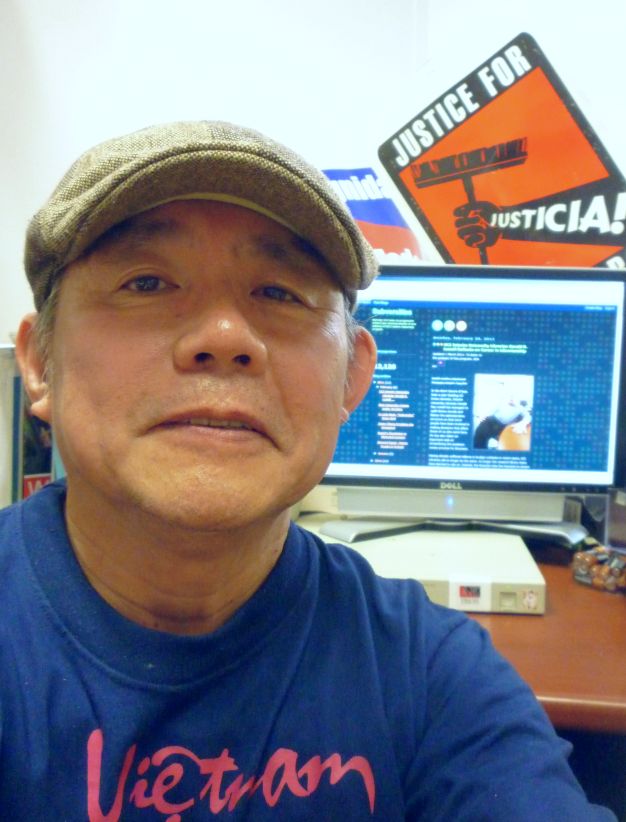
Self-portrait in the UCI office, taken right after taping of the interview 4 March 2011 for East 306. Photo © Daniel C. Tsang, 2011.

An enterprising Asian Studies undergraduate class at McGill University in Montreal has an intriguing mission: Create an experimental radio program to document social change in Asia and the Asian diaspora by interviewing activists, scholars and the like.

So I was honored to be one of those interviewed in the project, East 306, whose blog posts audio of past interviewees. Its post today profiles Subversity and my work on and beyond the show.

The back story: The class is co-taught by the superlative Adrienne Hurley, a Japanese Studies doctoral graduate from UC Irvine. The first scholar interviewed by East 306's team of earnest students was another Japanese Studies Ph.D from UCI, Kota Inoue, who is now teaching at my alma mater (see below). The interview with me was conducted using the facilities of a pioneering radio radio station at McGill, CKUT, which is expected to also air this program.

Here's what the students wrote in generously profiling me (taken from their blog) [hyperlinks revised]:

Since the program first aired in 1993, Daniel Tsang has been the host of Subversity on KUCI, the student and community radio station at the University of California, Irvine. Every Monday at 5pm (8pm in MontrĂ©al), he airs critical commentary and conducts in-depth interviews for this internationally recognized program that serves as an open seminar via radio. You can listen live via the KUCI website and browse past interviews and topics here (where you’ll also find a web-exclusive archive). On Subversity, Dan makes available to the masses the voices and ideas of activists, librarians, dissidents, and scholars, including Prof. Dylan Rodriguez, with whom Dan spoke shortly after the last U.S. presidential election. He has interviewed the actor Dustin Nguyen and the director Stanley Kwan, and he has covered a wide array of topics ranging from breast cancer (in a memorial tribute to UC Irvine graduate student Robyn Shikiya) to the ideological screening out of radicals in graduate and professional schools (in an interview with Jeffrey Schmidt).

Dan Tsang is also Data Librarian and Bibliographer in Asian American Studies, Political Science, and Economics at the University of California, Irvine, where he organized the Immigrant Lives Exhibit to debunk ‘The OC’ TV image of Orange County. He maintains Subject and Course Guides in fields such as Asian American Studies, Political Science, Economics, and the Social Sciences. He earned his B.A. in Government from the University of Redlands, where Professor Kota Inoue (interviewed in our very first podcast) currently teaches. Dan Tsang went on to earn two graduate degrees at the University of Michigan, an M.A. in Political Science and an M.L.S. in Library Science. As a journalist, Dan has authored numerous articles and opinion pieces, as well as scholarly publications, which you can see listed here. In today’s podcast, Dan mentions Elaine Black Yoneda, a white woman who joined her Japanese American husband in the internment camp. Dan’s biographical entry on her is the last entry in Notable American Women: A Biographical Dictionary Completing the Twentieth Century (Cambridge, MA: Belknap Press, 2004), Vol. 5, 707-709.

Dan edited the magazine Gay Insurgent in Philadelphia in the early 1980s. He was a Fulbright research scholar at the National Academy of Social Sciences in Hanoi, Vietnam in 2003-2004, and contributes greatly to our collective survival as a radical archivist, data librarian, indexer, and bibliographer. He also sued the CIA for spying on him and won. (He discusses this case in today’s podcast.)

Samantha Chrisanthus, who studies Political Science and Women’s Studies at McGill, interviews Dan Tsang about his work in libraries and radio stations, as well as his efforts to document and archive injustice and harm. Sam begins by asking Dan how Subversity started and what led him to radio. In this lively and very informative interview, Dan discusses topics such as how to document police harassment and abuse, the chilling effects of the current case of the Irvine 11 on student movements and student activism, and why we need data liberation movements and radical archiving. Dan also talks about obtaining FBI files on dead activists (and philosophers) and why we should think about preserving our own archives while we are still here and making them.


As host of Subversity I usually get to interview activists; given that they have turned the tables on me, let me return the favor and air the interview on KUCI as well.

The show with this free-wheeling interview by Sam Chrisanthus of myself airs this evening from 5-6 p.m. on KUCI, 88.9 FM in Orange County, California, and is simulcast via kuci.org.